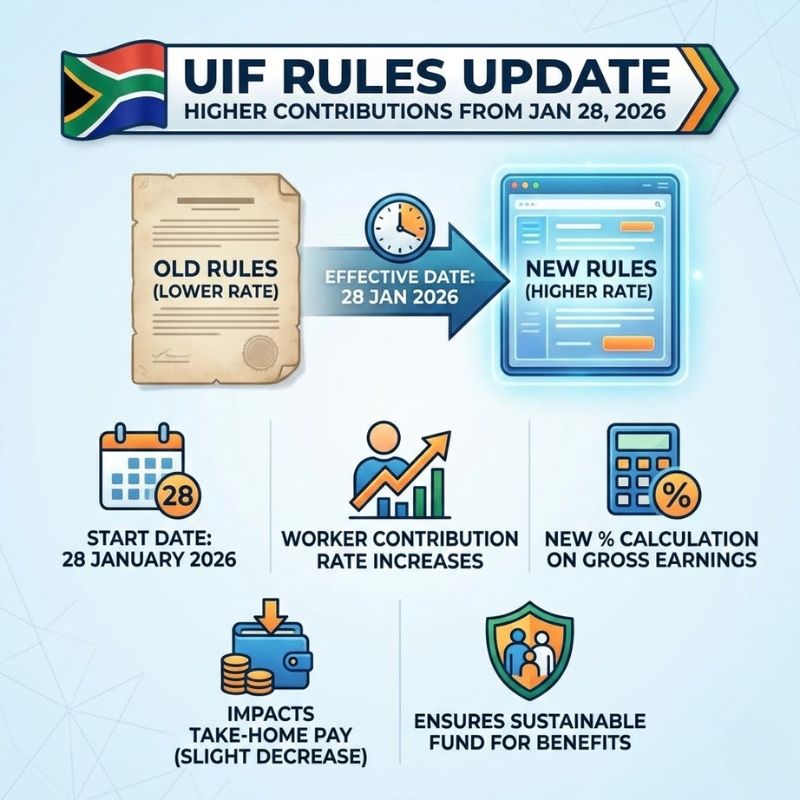
South Africa’s employment system is preparing for a significant change as the Unemployment Insurance Fund introduces higher contribution rates starting 27 January 2026. Workers & employers have become accustomed to the current payroll deductions over many years. However increasing demands on benefit payments and new policy decisions are changing how the UIF receives its funding. These adjustments are designed to provide better income protection for people who lose their jobs while keeping the system financially stable. With the implementation date getting closer employees in all industries are reviewing their payslips and companies are updating their payroll systems to meet the new national requirements.

UIF Contribution Rate Adjustments Begin Reshaping Payroll Deductions
From late January 2026, employees will begin noticing visible changes in their UIF deductions compared with previous years. The revised rules introduce higher contribution rates that directly affect monthly take-home pay, even if the adjustment initially appears minor. For many households, this increase in payroll deductions will require small but careful budgeting changes, particularly for those already managing rising transport and food expenses.
Employers are also affected, as they must account for the cost impact on employees while ensuring payroll systems calculate deductions correctly. Although the objective focuses on long-term income protection, the immediate reality is that employer adjustments are unavoidable. Payroll software, employment contracts, and internal policies must all be updated to comply with the new legal requirements.


How the Updated UIF Rules Affect Workers and Employers
The revised structure goes beyond simply increasing contribution percentages. It also refines how income limits and caps apply to earnings. Authorities have aligned deductions with an updated UIF contribution ceiling, meaning higher-income earners may now experience changes that were previously softened by older thresholds.
This recalibration introduces a clearer monthly UIF cap linked directly to wages, reducing uncertainty for payroll departments. Under the new model, a wage-based calculation formula guides deductions, making compliance easier to track but harder to overlook. Businesses that fail to meet compliance timelines risk penalties, making early preparation a growing priority across sectors.

Getting Ready for UIF Contribution Increases in 2026
Practical preparation can ease the impact of the January changes. Workers are encouraged to review payslips regularly, paying close attention to payslip verification to ensure deductions align with official guidelines. Employers should prioritise HR and payroll system updates well ahead of the deadline to prevent last-minute errors. On a personal level, early budget planning can help households adjust to slightly reduced net income without added pressure. If discrepancies occur, understanding dispute resolution processes and monitoring official notices can prevent prolonged issues and ensure all UIF contributions are accurately recorded.
What the UIF Rule Overhaul Signals for the Future
Looking ahead, the UIF changes point to a broader shift in worker protection policy in South Africa. While higher deductions may feel challenging in the short term, policymakers position the update as a move toward stronger social safety nets. By reinforcing the fund, authorities aim to sustain benefits during economic downturns and periods of job transition, keeping income protection at the centre of labour policy. For employers, clearer and more predictable rules support forward planning, while workers gain reassurance that their contributions support meaningful assistance. Over time, these measures are designed to promote long-term stability without weakening employment growth.
| Aspect | Old UIF Rules | New UIF Rules (From Jan 2026) |
|---|---|---|
| Contribution Level | Lower, familiar rates | Higher adjusted rates |
| Earnings Threshold | Previous capped limit | Revised contribution cap |
| Payroll Processing | Existing systems | Updated payroll calculations |
| Compliance Risk | Minimal if unchanged | Penalties for non-compliance |